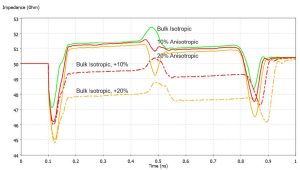
The “need for speed” in AI systems is driven by their requirement to process large data sets, both during training and application. Channel design is constrained by the balance between acceptable loss budget and the power consumed in equalization and error correction. Reducing channel loss can enable lower power or longer unrepeated channel lengths. Historically, high-speed serial links focused on material selection to manage attenuation. In 224 Gbps PAM4 systems, however, second-order factors like impedance variations, crosstalk, and power loss into cavities significantly impact the loss budget. While identically similar virtual channels can be designed in simulations, real fabricated boards differ due to manufacturing variations and limited understanding of material anisotropy. As channel bandwidths increase to 56 GHz and above, accurately defining material behavior in simulations becomes crucial. This paper analyzes second-order design features using precision measurements of test vehicles and digital twins. We propose a metric-driven methodology based on AI/ML to determine relevant parameters for simulating anisotropic behavior that matches both time and frequency domain measurements. When second-order factors are accounted for, it is possible to align our predictions from the simulation more robustly with the measurements of what was manufactured. In other words, the virtual design, aka the digital twin, allows us to predict the actual system performance more accurately. These digital twins, combined with AI/ML techniques, allow for design space exploration and sensitivity analysis to identify manufacturing tolerances and assists us in creating robust 224 Gbps PAM4 channels with acceptable total loss. The paper includes a study of the influence of anisotropy on the channel performance and examines methods to extract out the level of anisotropy. The overall goal is to achieve better than 2% measurement-simulation correlation in impedance profiles. This approach allows for optimized geometries and controlled geometry designs.